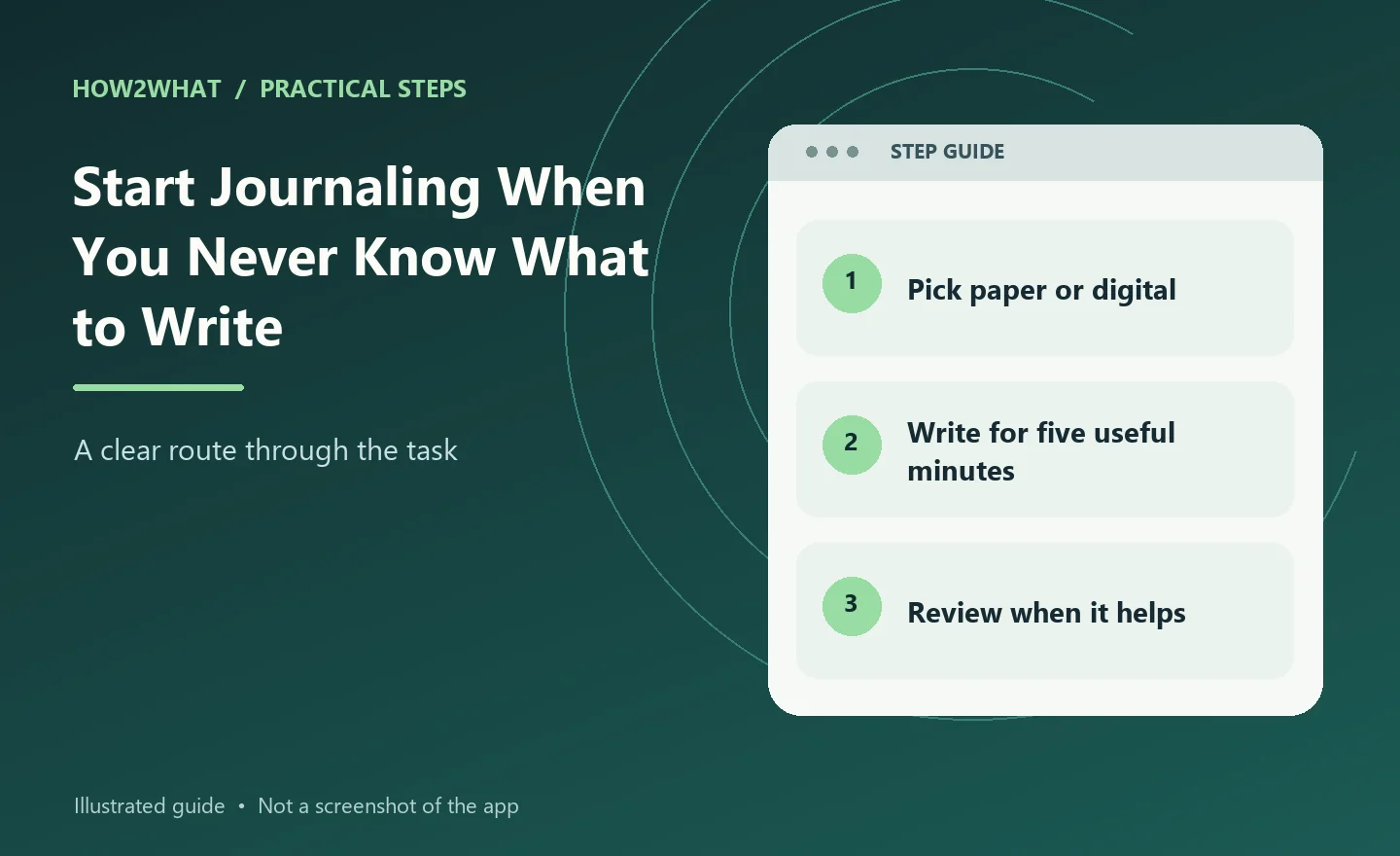
Journaling is easier to keep up when it has a purpose. You do not need an expensive notebook, perfect handwriting or half an hour every morning. You need a place to write and a reason to return to it. That reason can be practical: clearing your head, planning work, recording memories, tracking habits or thinking through decisions. The format can then fit the job.
Pick the easiest format
Paper is simple and distraction-free. A notes app is searchable and always with you. A private document on a computer works well for longer entries. A dedicated journal app can add prompts, tags and reminders. None is inherently better. If you keep buying notebooks and never using them, try digital. If typing turns into tab-switching and distraction, try paper. The best format is the one you will still use after the novelty wears off.
Decide what the journal is for
A vague instruction to "write about your day" can feel like homework. Give the journal a job.
Examples:
- capture thoughts before bed;
- record one useful thing learned each day;
- think through difficult decisions;
- plan tomorrow;
- document a project;
- track training or creative work;
- preserve family memories;
- practise writing;
- note what is causing stress;
- record things worth remembering.
You can use more than one purpose, but starting with one makes the blank page easier.
Start with five minutes
Do not begin by promising yourself three handwritten pages every morning forever. Set a five-minute timer. Write until it ends. If you want to continue, carry on. If not, stop. A small routine is easier to repeat than an ambitious ritual. After a few weeks, you may naturally write more. The habit matters before the volume.
Use a repeatable prompt
A simple prompt removes the decision about where to start.
Try:
- What is taking up most of my attention today?
- What went well?
- What frustrated me?
- What am I avoiding?
- What do I want to remember from today?
- What is the next useful action?
- What changed my mind this week?
- What am I grateful for, specifically?
- What would make tomorrow easier?
- What am I worrying about that I can actually influence?
You do not need a different inspirational prompt every day. Repeating the same three questions can produce a useful record over time.
Write badly on purpose
A private journal does not need polished sentences. Use fragments. Cross things out. Repeat yourself. Change topic halfway through. Write a list instead of paragraphs. The moment you try to make every page "good writing", you create an audience in your head and the journal becomes harder to use honestly. If a sentence communicates the thought to future you, it has done its job.
Try a simple daily structure
A practical entry can be:
Today: what happened.
On my mind: what you keep thinking about.
Decision: anything you decided.
Tomorrow: the next thing to do.
That takes a few minutes and produces more useful information than a forced page of general reflection.
For work journaling, add:
- completed;
- blocked;
- learned;
- next.
For personal journaling, you might use:
- good;
- difficult;
- memorable;
- grateful.
Morning journaling
Morning writing works well for planning and clearing mental clutter.
Before opening messages or social media, write down:
- what is on your mind;
- the three most important tasks;
- one thing likely to derail the day;
- what you will do if that happens.
This turns the journal into a decision tool rather than a diary. If mornings are already chaotic, do not force the routine. Evening may suit you better.
Evening journaling
Evening entries are useful for reflection. Keep them short enough that tiredness does not kill the habit.
Ask:
- What happened today that matters?
- What worked?
- What would I do differently?
- What needs carrying into tomorrow?
If writing late at night makes you dwell on worries, try keeping the reflective session earlier in the evening. NHS guidance on managing worries suggests writing concerns down and setting aside a dedicated time to consider practical solutions. The journal should reduce unfinished mental loops, not create more of them.
Journal when something happens
A journal does not have to be daily. Event-based journaling can be more sustainable.
Write after:
- a difficult conversation;
- a project milestone;
- a trip;
- an argument;
- a big purchase;
- a training session;
- an important decision;
- a new idea.
This creates a record around meaningful moments without requiring an entry on uneventful days.
Keep entries specific
"Today was stressful" tells you very little later. "Three urgent requests arrived before lunch and I kept switching between them" gives you something to analyse. Specific entries reveal patterns.
If you are tracking mood or productivity, note the context:
- sleep;
- workload;
- exercise;
- social time;
- interruptions;
- environment.
Do not turn the journal into obsessive self-measurement, but enough detail makes reflection more useful.
Review it occasionally
Writing is only half the value. Once a week or month, skim recent pages.
Look for:
- recurring problems;
- repeated goals;
- unfinished decisions;
- ideas worth acting on;
- things that improved;
- things you keep saying you will change.
Mark useful entries with a simple symbol or digital tag. If you see the same practical problem appearing again and again, turn it into one action to try next week. The value lies in spotting what you can change, not filling pages for its own sake.
Keep private writing private
Decide where the journal lives. If paper contains sensitive information, store it somewhere appropriate. If digital, use a device and service with security suitable for what you write. Do not put passwords, recovery codes or information that would create serious harm if exposed into a casual journal. If other people use the same device, make sure the journal is not necessarily visible in shared folders or home-screen widgets.
What if you miss a day?
Do nothing. Do not write three catch-up entries because a streak broke. Open the next page and continue. Rigid streaks can turn a useful practice into another obligation. A journal that you use 150 days a year and genuinely value is better than one you abandon after a perfect 19-day streak.
What if you do not know what to write?
Write that.
Then answer:
- What happened in the last 24 hours?
- What am I thinking about now?
- What am I trying to decide?
- What am I looking forward to?
- What am I avoiding?
If nothing useful appears after five minutes, stop. You are allowed to have uneventful days.
A seven-day way to begin
For one week, write for five minutes at roughly the same time. Use the same three prompts:
- What is on my mind?
- What mattered today?
- What is the next useful thing?
At the end of seven days, read the entries. Keep what helped and discard what felt forced. That is enough to build a journaling practice around your actual life rather than somebody else's perfect morning routine.
Sources checked: University of Rochester Medicine: practical journaling tips and NHS Every Mind Matters: writing down worries.